
Redfish are one of the most exciting and accessible inshore gamefish in coastal waters. Also known as red drum, these fish tend to cluster around shallow flats and deep channels. In order to catch this game, you need to understand their natural habitat and behaviors so you can tailor your strategy to their environment.
In this guide, we will be breaking down the where, when, and how to catch redfish including their natural habitats, how tides impact their schooling patterns, and what equipment can dramatically increase your success on the water.
Where to Catch Redfish
The first thing you need to know when catching redfish is where you need to go to find them in the first place. The best way to track these locations is to understand redfish feeding behaviors and apply them to your local marine environments.
Redfish are opportunistic feeders, meaning they strike aggressively and precisely when presented with the few opportunities they can find in their natural habitats. They tend to move with the tides, tailing in shallow water while hunting for their prey.
There are several habitats that align with these environmental conditions. For example, shallow grass flats have grass and mud bottoms commonly home to shrimp, crabs, and baitfish – all types of prey that redfish tend to target. Similarly, marsh shorelines tend to also have aquatic grass where redfish like to feed in addition to oyster beds and small drains that funnel bait in tidal waves.
Another great place for catching redfish is in drop-offs along river channels. During the colder months and low tides, redfish tend to slip into these deeper sections of the river for safety and warmth.
When to Catch Redfish
Because redfish school patterns are highly dependent on tides, knowing when to go fishing is nearly as important as where. By watching the tides, you can accurately predict where redfish are going to cluster to hunt, which will make your fishing trip much more successful.
In low tide, redfish are more likely to school together as there are fewer opportunities for them to surprise their prey. These conditions are ideal for sight-fishing, as the shallow water also makes it easier to track their schools from above.
When the tide is falling, redfish tend to cluster in drains and channels. Fish in general do not like shallow water because it offers a higher risk of being beached and dying. When water levels are dropping, it only makes sense that fish will go to the deepest area they can find, which will naturally force them to cluster together. Targeting these deeper sections during falling tide is sure to result in large catch counts.
These behaviors flip when the tide is rising. Now that it has become safer to navigate the shallows, redfish will leave the drains and channels and tend to spread out, swimming more as individuals than schools in order to increase their chances of catching prey.
How to Catch Redfish
Once you know where and when to go fishing for redfish, it becomes instrumental to put together a peak strategy to make your trip successful. The trick to having a successful fishing trip can be split into two parts: developing the right strategy and having the right equipment.
Developing the Right Strategy
One of the best ways to catch redfish is through sightfishing. Redfish tend to prefer shallow water, which makes it easy to see them from a vantage point like a raised tower of a fishing boat. Wearing polarized sunglasses can make viewing from these raised towers even clearer.
From this raised viewpoint, it is important to look for wakes, tails, and mud boils. Wakes are tracks of disturbed water created behind boats and their disruption of the tide tends to scare off redfish. Tailwater is the tracts of flowing water dictated by tides and often act as fish highways, pushing redfish into grass flats where they “tail” or stand on their heads while foraging for crabs and shrimp in the grass. Redfish also tend to target mud boils to root around for crustaceans as these wells of pressurized air underwater tend to naturally attract crabs and shrimp.
Once you have found these spots, it is imperative that your movements stay slow and quiet so as to not disturb the fish. For similar reasons, it’s best to cast your line far beyond the fish, then slowly guide the lure into its path. Even when this strategy is performed perfectly, the wrong equipment can severely handicap your catch rate. That is where having the right equipment comes into play.
Having the Right Equipment
In the previous section, we touched on three pieces of equipment that are instrumental in having a successful fishing trip: polarized sunglasses, lures, and a stable boat. For polarized sunglasses, choosing a pair that fits your face well without being too tight will make sight-fishing exponentially easier. Additionally, wearing a sunglass strap can prevent loss of your glasses from the wind or misplacement.
As for bait, there is debate between whether it is best to use live bait or artificial lures. Live bait is extremely effective, especially for beginners as it naturally attracts redfish without any additional skill or effort. For redfish, it is best to use shrimp, finger mullet, or mud minnows. The negative is that live bait needs to be constantly replaced, which can get expensive over time.
Artificial lures do not have that same problem, as they can be reused several times. Additionally, they can come in bright colors that are easier to track when sight-fishing. For redfish, the best ones to use are soft plastic paddle tails, weedless gold spoons, and if fishing in the early morning, topwater plugs. Their negative is that they can be harder to get fish to bite due to their bright color and artificial nature, which makes them best for more skilled anglers.
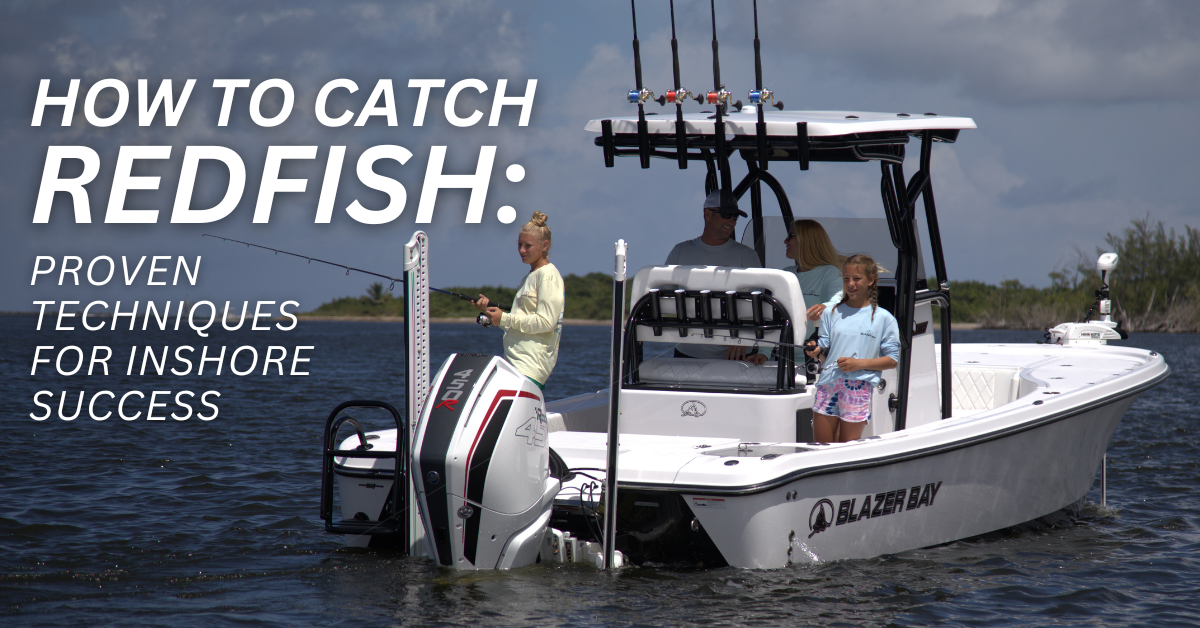
Lastly, there is the most important piece of equipment on your fishing trip: the boat that you are fishing from. A stable, shallow-running boat can make a huge difference when tracking redfish through grass flats, marsh shorelines, and channel drop-offs. It is best to look for boats that run extremely shallow, draft minimal water, pole quietly, and provide a stable casting platform.
There are several Blazer Bay boats that meet these requirements, each with their own strengths and weaknesses.
- The 675 Ultimate Bay is a fantastic option for those who want the professional angler experience and prioritize deck space, storage capacity, and speed.
- The Purebay 2400 and 2200 both offer an economical option that offers the most features at the best price.
- The 2400 Open Bay Striper is a versatile boat that can be used to catch a wide range of game beyond redfish including shrimp and crab.
- The 2400 is incredibly customizable, with three different layout options based on what best suits your fishing style.
- The 2440 is one of the most popular Blazer Bay boats, and it’s easy to see why. From its comfortable lounge to its expansive storage and plentiful deck space, it perfectly balances everything you could want for a trip with your friends and family.
- The 2550 GTS has several comfort features including a bow step cushion, but prioritizes professional angler features such as deck space, storage capacity, and dynamic design.
- The Makaira 2600, 2700 Hybrid, and Makaira 2800 all focus on providing a comfortable all-day ride for you and your family. Each one has a slightly different layout so you can choose the design that best suits you and your family’s needs.
Learning how to catch redfish is about being in the right waterways at the right time with the right equipment. If catching redfish is your game, then you need a boat that is built for the waters that they call home. Learn more about why serious inshore anglers trust Blazer Boats by contacting our team today.