
A livewell is one of those systems that gets ignored right up until bait starts rolling, water gets hot, or a tournament fish shows up stressed. That is why bay boat livewell features deserve more attention than a quick glance at capacity. On a serious fishing boat, the livewell is not just a tank. It is a working system that has to protect bait, keep fish healthy, and perform in rough conditions without constant babysitting.
For anglers who fish hard, the difference between an average livewell and a well-designed one shows up fast. Frisky bait lasts longer. Tournament fish stay stronger. Cleanup is easier. And the entire day runs better because you are focused on fishing instead of trying to fix problems that should have been solved in the boat’s design.
Why bay boat livewell features matter on the water
A bay boat has to do more than one job. It may spend the morning sight-casting on a flat, run through a choppy bay by noon, and finish the day with the family cruising or sandbar hopping. That means every fishing feature has to work under real-world pressure, not just look good in a brochure.
The livewell is a perfect example. Inshore anglers may need shrimp, pinfish, croakers, or pilchards to stay lively for hours. Tournament fishermen need reliable fish care, especially in heat. Even weekend anglers benefit from a setup that is easy to use and easy to trust. The right livewell system supports all of that. The wrong one can cost you bait, fish, time, and patience.
Capacity is only the starting point
Most buyers look at gallons first, and that makes sense. A bigger livewell usually gives bait and fish more room, which can reduce stress. But size alone does not tell the whole story.
A large livewell with poor circulation can still be a problem. A smaller well with smart plumbing and proper shape may outperform it in actual fishing conditions. It depends on how you fish. If you are loading up delicate bait for a long day, extra capacity helps. If you mainly need a reliable well for a few keeper fish or short inshore runs, layout and water quality may matter more than pure volume.
The best approach is to look at capacity as part of the system, not the headline feature. A serious bay boat should pair usable volume with smart water management, dependable pumps, and a layout that keeps the well accessible when the action picks up.
Livewell shape affects bait and fish survival
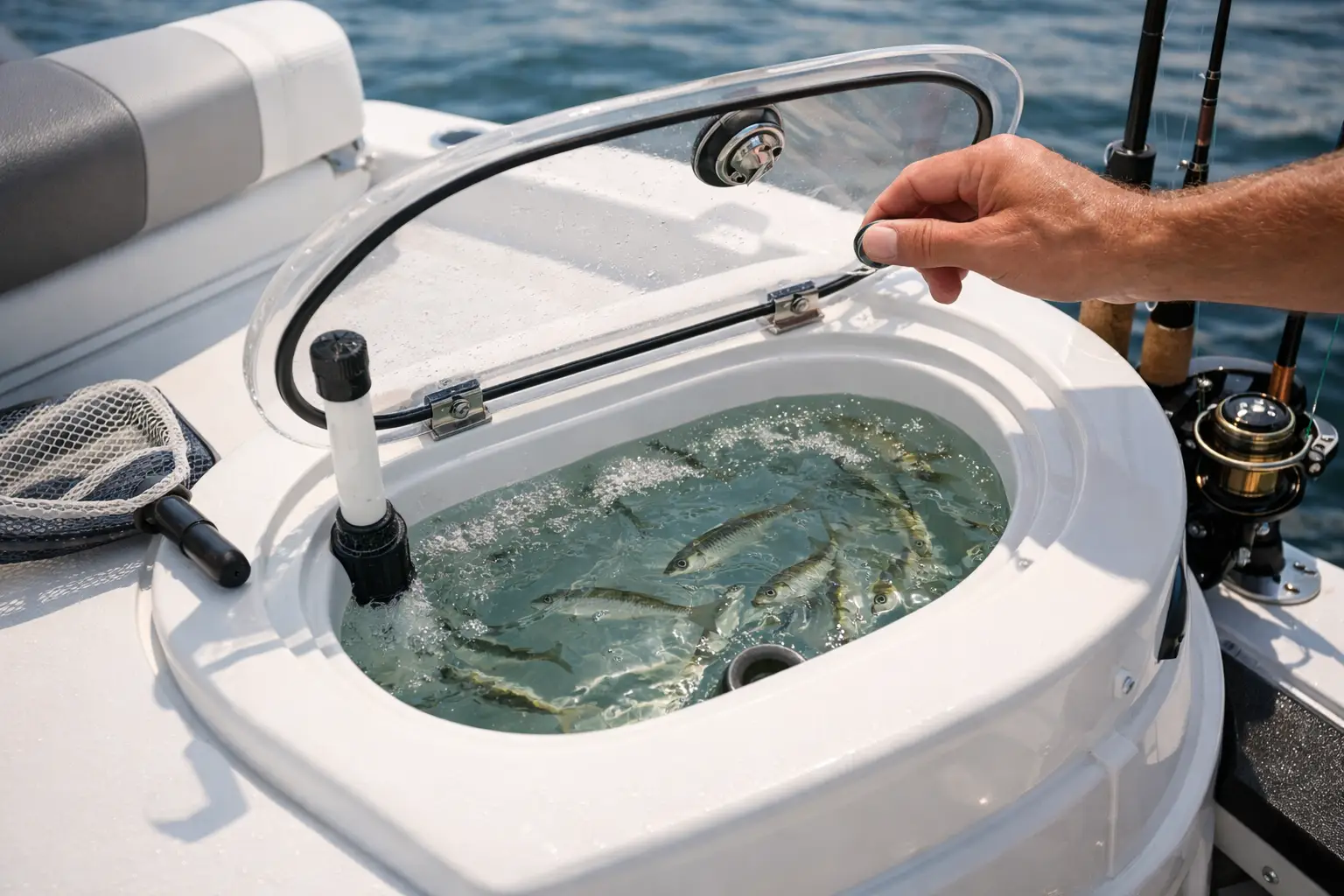
One of the most overlooked bay boat livewell features is the shape of the tank itself. Corners are not your friend. Baitfish get pinned, roll, and stress faster in square designs, especially when the boat is moving. Rounded or oval livewells allow bait to swim naturally and reduce the chance of injury.
That matters more than many buyers realize. Healthy bait is active bait, and active bait gets more bites. The same principle applies to keeping fish in better condition before weigh-in or release. A well-designed interior helps prevent beat-up scales, damaged fins, and unnecessary stress.
This is one of those details that separates a fishing-first boat from a boat that simply checks the livewell box. If the design team understands real angling use, it shows here.
Pump performance and circulation are where the work gets done
A livewell only performs as well as its plumbing. Pumps, intake design, recirculation, and water exchange all matter. Fresh water inflow keeps oxygen levels up and helps regulate temperature. Recirculation gives you control when you are running, fishing shallow, or dealing with conditions where constant raw-water exchange is not ideal.
For serious use, reliability matters as much as output. A high-capacity pump sounds great until it fails or struggles after a season in saltwater. Strong bay boat design means choosing components that can handle real use and giving the owner a setup that is easy to monitor and manage.
Spray heads and fill locations matter too. Water should enter in a way that promotes circulation without beating up bait. Too much force in the wrong spot can stress bait just as quickly as poor oxygenation. A balanced flow is what you want – enough exchange to keep the well healthy, without turning it into a washing machine.
Oxygen, aeration, and temperature control are not extras
If you fish in the South, summer heat exposes weak livewell systems fast. Warm water holds less oxygen, and that puts immediate pressure on both bait and fish. That is why premium bay boat livewell features often include stronger aeration support, efficient recirculation, and insulation or design choices that help manage heat.
This is especially important for tournament anglers and for anyone keeping bait alive through a long day. Even a great hull and top-end motor cannot make up for a livewell that struggles in hot conditions. Water quality is the game.
There is also a trade-off here. More advanced systems can mean more components and more setup choices. That is not a bad thing if the controls are simple and dependable. On a performance-minded bay boat, the goal is not complexity for its own sake. It is control, consistency, and confidence.
Lid design and access matter more than people think
You should not have to fight your livewell while a fish is blowing up on the flat. Good lid placement, smooth hinges, and easy access all make a difference when every second counts.
A solid lid also helps with insulation, water retention, and bait security in rougher conditions. Clear lids can be useful if you want to check bait without opening the well constantly, but it depends on preference and how the rest of the boat is laid out. Some anglers want instant visibility. Others care more about durability, clean deck design, and minimizing heat gain.
The right answer depends on how you fish, but poor access is never acceptable. If the well is awkward to open, placed where crew movement gets jammed up, or difficult to reach from the casting position, that is a design miss.
Drainage and cleanup are part of performance
A livewell should be easy to drain, easy to clean, and easy to reset for the next trip. That may not sound exciting, but every experienced boat owner knows the value of simple maintenance. Salt, scales, slime, and leftover baitwater can become a headache quickly if the well does not drain completely or clean out easily.
Smooth interior surfaces, smart drain placement, and hardware that holds up in a saltwater environment all matter. This is where quality construction shows itself over time. A good bay boat is not just fast and dry-riding. It is built to stay fishable and owner-friendly season after season.
Redundancy and control separate casual setups from serious ones
For hard-core anglers, dual livewells or separated systems can be a major advantage. You may want one well for bait and one for fish. You may want to separate shrimp from finfish. You may want backup capability if one pump acts up. Not every buyer needs that level of setup, but for some fishermen it is a real difference-maker.
Control systems matter too. Timers, pump switches, recirculation modes, and easy access to valves can take a livewell from basic to tournament-ready. The best systems do not demand constant attention. They let you make quick adjustments and get back to the water in front of you.
That is where a performance-focused builder has an edge. When a company understands that layout, rigging, and fishability all work together, the result is a boat that feels right from the first run. Blazer Boats has built its reputation on exactly that kind of purpose-driven design.
Choosing the right livewell setup for your style of fishing
Not every angler needs the same livewell package. If you throw artificials most of the time and only occasionally carry live bait, your needs are different from a guide, tournament fisherman, or serious weekend angler who depends on bait performance every trip.
If live bait is central to your program, prioritize shape, circulation, access, and water quality control over flashy add-ons. If tournament fish care is a big part of your fishing, look for systems built to reduce stress and simplify management throughout the day. If your boat has to balance hardcore fishing with family comfort, the livewell should still be integrated cleanly without compromising deck flow or storage.
That is the real standard. The best bay boat livewell features are not about one spec in isolation. They are about how the system works with the rest of the boat – how it supports your fishing, holds up in your conditions, and helps you stay efficient from launch to the last cast.
When you are shopping for a bay boat, treat the livewell like a core performance feature, because that is exactly what it is. A strong hull gets you there. A great livewell helps you finish the day the way you planned.